Showing posts with label artist interview. Show all posts

Thursday, June 25, 2015

Artist Interview: Yinfan Huang

profile_yinfan

Meet Yinfan Huang. Yinfan is a freelance illustrator based in New York, creating whimsical and playful work influenced by world travel and folk art. She grew up in a city called Guangzhou in Southern China, and briefly studied animation and printmaking in Chinese college before she came to the US to pursue her BFA in illustration at the Minneapolis College of Art and Design. She has worked for clients such as 3M, Anorak Magazine, Children's Theater Company, and more.

We're excited to chat with Yinfan about her inspirations, travels, ongoing projects, and more! We have had the pleasure of working with Yinfan for the Smart exhibition, Anymistics, and presently Patches + Stitches. We'll talk about her interest in textiles and soft sculpture, and details about her piece for the Stitches side of the Patches + Stitches show. You can see more of Yinfan's work on her website as well!

Tell us about your workspace! How does your environment affect your creativity?

Because I work traditionally, having a quiet workspace with lots of light is important for my practice. Right now my workspace is in the living room and bedroom of my apartment. It is perfect for my current situation, but I would love to have a separate studio someday.

studio_yinfan

Your work focuses heavily on playful colors and textures. What is your approach to using materials to accomplish this?

I have a deep appreciation for everything handmade, so I want to keep the tactile quality in my work. Colored pencil has a soft feeling to me and I like to use it for illustration. I also use materials like wool, felt, and clay for my 3D work- they just feel natural for me to work with. Even for my digital work I tried to keep the handmade touch. I like bright and playful colors, which make me feel happy, and I hope my work makes people happy as well.

There is a sense of happiness and innocence in your creations. How do you get inspired and stay motivated to make your work?

I get inspired a lot by the places I live in. Walking in the city and taking the subway provide me with endless inspiration. Although I have spent most of my life living in big cities, the early years of my childhood living in a small town has played a big role in my life. I still connect deeply with nature and animals, I think that’s why my work has an innocent feeling to it.
Yinfan Huang_Fun Playing Cards

Moving from China, to Minneapolis, and now living in New York, has moving around influenced your work in any way?

Definitely! like I said before, I am influenced largely by the environment I live in. Moving to the US has broadened my horizons and made me grow as a person and an artist. Minneapolis is a beautiful city with great nature and nice people, which gave me so much freedom to play with my work. However, it got to a point where I needed to have more energy and a bigger art community around me, so I decided to move to New York. Living in New York has given me so much inspiration and my work has improved a lot because of that. I often have ideas when I was traveling, either on plane or train. I would like to travel more in the future, but moving is always a huge pain!

Now that you are located in New York, have you had any opportunities to collaborate with other creative people who live there?

I recently collaborated with my friend Xinyun Huang for my on-going creative project pomegrandate Boy. We took the life-size plush toy I made to different places in NYC and took pictures of him. We’ve made postcards out of these photos and we’ll sell them at the Renegade Craft Fair on June 27th which I’m excited to participate in- it will be my first craft fair in New York!

Who are some of your artistic role models?

Maria Kalman is one of my favorite illustrators I discovered when I first moved to the US. Her work is so innocent yet sophisticated with poetic text, which has inspired me a lot. I also like the art of Kiki Smith, Marc Chagall, Japanese textile designer Katsuji Wakisaka, Swedish graphic designer Olle Eksell,Marc Boutavant, Japanese designer Yoshie Watanabe. Just to name a few!

08.Yinfan Huang_Happy Wishes
Anorak Magazine, "Happy Wishes"

What has been your favorite project recently?

The UK children’s magazine Anorak recently asked me to do a two-page activity illustration for their Cats & Dogs issue. The illustration I did is called “Happy Wishes”, which was inspired by one of my personal illustrations called “ List of Happiness”. The art director gave me the freedom to design the whole double-page spread. I drew some happy scenes on the left side of the page, and put some empty boxes on the right hand side for kids to fill in with their own wishes. It was such a fun project to work on!

You work a lot with textile and soft sculpture. How does this kind of work relate to your illustration work?

I started making clay sculptures and plush toys when I was studying animation in China and we had to make puppets for a stop-motion animation. Years later, I first made a 3D piece for one of my illustration assignments in MCAD, which made me realize I could incorporate 3D materials into my illustration to make it look more interesting. I think my 2D illustration and 3D work inspire each other which creates a nice balance for me. I’m so glad I have something else to work with besides drawing on paper or on the computer, that way I will never get tired of doing illustration!

Yinfan_Cat Faces

Patches and Stitches is a show that will celebrate the beauty and breadth of textiles. Could you indulge us a bit about your piece for the Stitches side of the show?

Seoul Memories is a hand-embroidered piece I created based on a sketch from when I was traveling Seoul, South Korea in 2011. I remember I was sitting in a coffee shop near Ewha Woman's University and I drew a quick colored-pencil sketch of the view by the window. It was one of the best trips of my life and I think that drawing captured my impression very well. So I decided to transform my memories into a tangible format as embroidery. It was a challenge for me because this is my first time doing a fully illustrated embroidery, and I tried different stitching technique in this piece. It took me forever to finish but I am very happy now that it is complete.

Thanks Yinfan! You can see Yinfan's piece, Seoul Memories, at the upcoming Patches + Stitches exhibition, which will be happening July 3rd at 7PM at Light Grey Art Lab! You can also check out Yinfan's website or blog to see more of what she is up to!

Saturday, May 9, 2015

Artist Interview: Daniel Shaffer

Meet Daniel Shaffer. Daniel is an illustrator living and working in Baltimore, MD. Daniel is know for his colorful illustrations and narrative images. His work has been shown in various galleries and recognized by the Society of Illustrators. Daniel has participated in the BOSS RUSH!, Guts, and upcoming COSMOS projects with Light Grey Art Lab, and we are thrilled to showcase his artwork! You can read all about his expriences, resources, and thougts on illustration. You can also see more of Daniel's artwork on his website and blog here!

profile

Hi Daniel. Could you tell me about yourself?

I grew up in a city called Decatur which rests right outside of Atlanta, GA. I have really fond memories of Decatur and the neighborhood I grew up in. Decatur is lush with vegetation and tall oak trees and it smells really beautiful during the Spring and Fall. As a kid I was always using my imagination to become dinosaurs and animals, and I was interested in drawing and painting from imagination. I pretty much knew I wanted to be an artist when I was in Elementary school. After high school I attended the Maryland Institute College of Art (MICA) for four years and got my BFA last May. It took me a year in college to figure out that I wanted to become an illustrator.

You recently participated in the BOSS RUSH Exhibition, and much of your artwork in inspired by video games and media. Could you talk a little about your inspiration- are you attracted to the characters, story lines, bad guys, etc?

The BOSS RUSH! Exhibition was actually a turning point for me stylistically. I think once I graduated from college, I felt like I had a ticking clock behind me to get jobs so I started making a mad flurry of work. During this time I made a massive amount of experimental illustrations with shifting subject matter and style. At one point I was working completely flat and was pretty inspired by Joan Cornella's comics. I have always enjoyed gross humor so it was fun to paint a lot of butts and blood. What I really love though is color and atmosphere. I decided that my love for video games would be a good conduit for creating illustrations that pushed those two themes. When I saw the BOSS RUSH! call for artists I jumped on the opportunity because I thought it would be a good way to push myself to create a more polished piece than the illustrations I had been making prior. From there I decided to continue making movie and game related pieces because I knew that the passion was already there so all I had to do was create the image that I wanted.

bossrushfinalsmall
Majora's Mask for BOSS RUSH!

Your work includes lots of playful characters, humorous scenarios, and dramatic moments. Could you talk a little about storytelling and image making. What is most compelling to you when creating artwork?

I grew up watching cartoons and anime so I was exposed to a lot of different ways to tell a story through images. Studio Ghibli had a really big impact on me as a developing artist and as a growing boy. The movie Princess Mononoke was a treasure trove of inspiration. In the third grade my friend rented the movie at a sleep over and I watched it for the first time. I don't think my mom would have been too happy that I had watched such a violent movie, but I couldn't stop thinking about it- I felt like it was one of the greatest creations known to man. I remember running as fast as I could through the little forest behind my school pretending I was running with wolves. So much of the world was unknown to me so I had to make up what I believed could be true. I think that's what's so compelling about making artwork. You get to create whatever you want in your own way.

ghiblijamsmall
Princess Mononoke

What is your favorite piece/project to date? What do you want to work on more?

I think my favorite piece that I've made was my tribute to Princess Mononoke. Not because it's dedicated to Princess Mononoke, but because it was a piece where I felt like I had unlocked something in myself that made the piece flow really well for me. It was one of the first times that developing the composition, colors, and lighting felt really natural to me and I just kind of knew what needed to be done. I definitely would like to continue doing tribute pieces, but I would also like to start working on my own children's book.

For the Guts Exhibition, you were tasked with investigating the insides of something. Could you tell us about that project, what you uncovered, and what you wanted to share?

For the Guts Exhibition I decided to choose the mythological Cosmic Turtle as my subject matter. Commonly in the mythology surrounding this creature, the turtle is swimming in space while holding a flat earth on its back that is being supported by four white elephants. Terry Pratchett actually wrote a series called Discworld that takes place on the earth that is supported by a cosmic turtle. I have yet to read the series, but it sounds really interesting. I decided to put a twist on the myth by making the action take place within the shell of a turtle creature instead of on top. I liked the idea of the shell creating a micro system of entities and foliage, while also protecting an entire universe which is represented by the white orb in the center. I thought this provided an interesting concept that could indicate an infinite number of cosmic turtles holding an infinite number of universes and how fragile this system is. It's scary and interesting to think about how the death of one Cosmic turtle could affect all the others that lie within it.

finalsmall
Protecting Life (Cosmic Turtle) for the Guts Exhibition

Could you describe your creative community? Locally or online? What things do you look for in a community?

At the moment I am still living in Baltimore right next to the MICA campus. I live in an apartment with artist and friend Matt Rockefeller. A lot of this past year has been dedicated to Matt and I working alongside each other in our in home studio. We often give each other feedback on the projects we're working on and also take breaks to go outside or play through different video games. At the end of June I am going to be moving back home in Decatur, GA to save some money. I will have lived in Baltimore for 5 years so the shift back home will be an interesting change for me. Community is still a concept that I'm learning about and take for granted. I was born with a chemical imbalance that makes my anxiety levels sky rocket pretty easily so I typically maintain a pretty small group of friends so that I'm not over stimulated. With that said, I think I need to be surrounded by an artistic community/atmosphere that share some of my core values in life. It also helps if my community is surrounded by lots of vegetation and animals! I would much prefer my view of the sky to be blocked by trees than blocked by buildings.

As an young illustrator, what is the most valuable piece of information/advise you have received?

I'm not sure if anyone ever specifically told this to me or if I just decided it was good advice on my own, but I would say the most valuable advice for me has been to just keep making work. I have only grown after making hundreds of things. The journey is often difficult and can sometimes feel hopeless, but I have found that as long as I keep producing work I will grow and improve as an artist.

arrivalsmall
Arrival

What are some of your biggest sources of inspiration? (books, media, places, games, people, etc.)

As I mentioned before, Studio Ghibli has had a profound influence on me. Beyond that I would also say that Calvin and Hobbes influenced my thinking about the world. I was introduced to Calvin and Hobbes as a little kid. My dad bought me one of the compilation books that has lots of comics in it and I was immediately hooked. I really love how Bill Watterson writes his characters. There is something that is just so charming about the world that Calvin and Hobbes live in. It always makes me happy to read his comics.

What projects do you have in the works? What direction do you see yourself going in the next year to two? Any dream projects?

I'm in a transition period at the moment, so I don't have any specific projects in the works. I have been working on a collection of zines with my friends Boya Sun and Matt Rockefeller that will have the work of a bunch of different artists in them. The title of the collection is Bloom, and it won't be finished for a while due to the number of zines and artists we're working with. There will be more information about that in the future though. As for my direction, I would say that I want to head into book publishing in some form. I also want to do editorial work, so I'll be building up clientele to work with in the coming months. In the future I would like to work on my own children's book. I have wanted to do that since I was a little kid. I'll be working on a story in the near future!

Thanks, Daniel!

You can find more of his work on his website, blog, and the Cosmic Tuttle piece on the Light Grey shop here! The Guts Exhibition will be on display and online through May 15th.

Saturday, March 28, 2015

Artist Interview: Victor Maury

Meet Victor Maury. Victor is a French artist, living and working in Sarasota, Florida. Victor is known for his fantasy characters, concept art backgrounds, and video game inspired digital paintings. His work has been recognized and celebrated by art magazines, gaming companies, and publishers such as Fantasy Flight Games, Riot Games, and Bifront Entertainment. Victor has also participated in several Light Grey Art Lab exhibitions and publications including In Place, Rolemodels: Battle for Vyk' Tornaahl, and the current BOSS RUSH! project.

We are thrilled to work with Victor on the BOSS RUSH! Exhibition and celebrate his process and artwork. Below, you can read more about his thoughts on illustration, participation in the community, and goals. You can also view more of his work at victorymaury.com

Victor Maury Interview

Hi Victor. Can you tell us more about yourself, your background, and where you are headed?

I was born in small-town France and moved to the US when I was seven years old. A lot of my work is influenced by my visits to the French countryside and the Pyrenees as a kid with my family. I've always loved to draw, but only began studying art seriously about four years ago, starting with animation and now illustration. I've been freelancing for about two years and expect to graduate from the Ringling College of Art and Design this May. After graduation, I plan to move out to California. My priority in life is to go on adventures and experience new things- art simply allows me to explore that in a personal way and share it with others.

What is your studio setup like? What materials do you most enjoy?

I try to keep my workspace clean and tidy, just the essentials: A semi-powerful PC + monitor and my trusty Cintiq 21 that I've had for about 4 years. Oh, and my speakers, cos jams are super important! My room is decorated with artwork from some of my incredibly talented friends. This is where I'll do most of my finalized paintings. When I'm brainstorming or sketching, I like to leave the house and go outside, any excuse to go exploring!

Victor Maury Interview

What is your creative process? Do you prepare yourself mentally for art creation, or do you dive right in? And if so, how?

When I get an assignment or an idea, I like to let it simmer for a bit in my head (if time permits). I find that once I start thinking about a project, random things in my life will coincide with or inform the finished piece. This allows me to integrate real life into every painting in a way that feels organic and natural. I also thoroughly research my topic. I scribble a thumbnail here and there, I stay loose but draw with intention. Once I have the essence captured in the thumbnail and all necessary reference collected, I move on to painting. The painting process is usually pretty fast because at that point I have everything mostly figured out and it's just execution. I like to paint in a couple of sittings so I don't overwork a piece if I can help it.

Victor Maury Interview

What inspires you? What imagery you are drawn towards using in your artwork, and what about it excites you?

A healthy mix of contemporary and deceased artists, photos, fashion, film, the natural world, and most importantly my own experiences! As far as recurring imagery, I don't think it's any secret that I'm obsessed with giants and clouds. I'm also fascinated by roots, moss, rust, fungus, rocks, mountains, gnarly old man faces, knobbly hands and various other rough, weathered, or organic shapes. I love riding my bike and going hiking, where I often see faces in the trees, sleeping giants in the mountains or kingdoms in the clouds.

What are your favorite creative resources, whatever they may be?

I follow a couple art blogs like Muddy Colors, and sometimes take the time to listen to a podcast here and there. My facebook feed is almost exclusively professional artists, and we're pretty good about sharing interesting resources (and distractions).

Victor Maury Interview
Run for Your Buns

What are your favorite video games or video game moments? What significance do games have to you?

I have played more hours of Fire Emblem, Advanced Wars, and League of Legends than I'd like to admit, but the single most influential game I've ever played is definitely Shadow of the Colossus. The scale, simplicity, score, design, and mood are unmatched. It feels like a game that was made specifically for me. If you ever wanted to understand how my brain works, the closest you could get would be playing Shadow.

Can you talk about your idea and process for creating your piece for Light Grey Art Lab's BOSS RUSH!?

I'm surprised I haven't made Shadow art before (though some might consider most of my portfolio to be Shadow fanart anyway haha). I just wanted to make a very simple piece that captures the mood and scale I felt in the game. Another thing I really wanted to play with in this painting was texture and surface. I intentionally used artifacting and layer mode glitchiness to add a gritty quality to the painting.

Victor Maury
The 3rd Colossus

Are you working on any exciting projects? What are some of your "dream projects" that'd you'd really like to work on?

I am! I'm currently wrapped up in a project I'm really excited about, a sort of reinventing of the Little Prince. I am focusing on character design and pushing my shapes and understanding of how to communicate personality visually. It's a project that's very dear to me and I can't wait to share it when it's done! I'm not sure what my dream project would be, maybe a collaboration with friends to make a game would be fun. I just want to keep learning and see what comes my way!

Thanks, Victor, for sharing your thoughts and process!

Again, you can see more of Victor's artwork on his website and tumblr here. You can also find his piece for the BOSS RUSH! Exhibition on the Light Grey Shop and website! His work will be available on the Light Grey Shop through April 10th. Victor's Shadow of the Colossus piece was nominated as one of the top ten in the exhibition by our guest jurors from Microsoft, Game Informer, Gearbox, and Glitch.

Thursday, October 30, 2014

Artist Interview: Ashley Hohnstein

Hohnstein_Selfie

Meet Ashley Hohnstein. Ashley is a fantastic graphic designer, art director, illustrator, and printmaker living and working in Minneapolis, MN. Originally from Oconomowoc, Wisconsin, she attended and graduated from the University of Wisconsin-Stout with Graphic Design. During college, Ashley discovered her love for process, illustration and hand lettering, and has continued to apply this passion and techniques to her work today. Ashley is an incredibly prolific creative, initiating several personal projects, working with local and national clients, and exploring new mediums and formats to enrich her art practice. Ashley is currently an Associate Graphic Designer at Target for their in-house creative studio.

We have had the opportunity to work with Ashley in several Light Grey Art Lab Exhibitions, such as Stacks and the current Skate or Die Skatebaord Show. It is always a pleasure to see her intricate line work, gorgeous letterings, and sensitivity to design applied to the exhibition topics and themes! We are thrilled to present Ashley's work, share her inspirations, and learn more about her process! You can check out Ashley's work on her website here, and view her work for the Skate or Die Exhibition on the Light Grey Shop.

Hohnstein_Studio1 Home Studio

Could you describe your studio practice? What is your space, items you are surrounded by, studio rituals? Do you have any must-have materials?

When working at night and on weekends, I have a pretty good studio space in my apartment. It’s actually technically a very small dining room. I have a big desk and a small laptop with a second monitor I plug into. Not because I work off of both screens, but because one of the main things I need to get work done when I’m alone is a steady non-stop steam of Netflix as background noise.

My walls are covered in printed ephemera, gathered from many years of what I can only call “selective hoarding” from antique stores, museum kiosks, abandoned houses, and bits and pieces of paper from everywhere. I like to spread out things when I work, so my desk is never tidy and tends to have stacks of sketches at both ends. I have a lot of different notebooks with different textures and grids, and love sketching with felt-tip pens and various brush pens, and have many different processes I use to take my work into the computer.


Hohnstein_Studio2 Home Studio Inspiration

At Target, I don’t have much control over my environment since it’s a large corporate office. I still have a double monitor set-up, though this one is without Netflix, and keep a good stash of pens and paper at work for doodling and sketching. My closet/shelf tower at the end of my desk is covered with a curated selection of the earlier mentioned printed ephemera that doesn’t fit on my walls at home. The really nice thing about my space at work is that it’s partially desks, and partially critiquing space, so the room is covered in in-process work from other brands that the team works on. It’s pretty cool to walk around and get inspired by the diverse body of work happening in the space!

Your work has a very whimsical and playful quality! What are some of your favorite ways of working, techniques, or designs?

When starting a project, I normally make a lot of lists and a plan of action before I really jump in and start. After that, I’m normally rapid ideating in large brain-dump lists and then I start sketching. If I’m doing something that’s hand-drawn, I’m normally starting in pencil and layer over it with tissue paper refining with different felt-tip pens, brush pens, or even india ink with different brushes. Then, I will scan that in and manipulate it in Photoshop until I get to the aesthetic I’m going for. Some work is a lot less fussy than others, of course. If I’m doing purely digital illustration, which for me is pretty geometric and vector based, I jump back and forth between sketching and Illustrator pretty quickly to test things, and then back to the drawing board. At the stage I’m currently at, I’m still exploring a lot of different styles. Sometimes I’m frustrated about that, and other times it’s really great- I’m trying to embrace it.

Skateboard_01 Graveyard

We loved having you contribute to the Skate or Die Exhibition! Could you describe your process for the project? What were your considerations, concepts, and topics?

I LOVED this project, thank you so much for giving me the opportunity to contribute. I love all things creepy and spooky, and combined with my middle school desire to be a skater kid (even though I have no coordination whatsoever and everyone called me a poser) - it was a perfect storm for me. I actually jumped around quite a bit with what I wanted to do, originally settling on an overly-ambitious idea to do a board covered in icons from all genres of everything spooky (movies, halloween, ghost hunting, etc.), with no repeats. It was crazy. I don’t know what I was thinking. So, as with most of my projects, I had a “get real” moment and re-adjusted my expectations and made myself actually choose an idea vs. doing all of them. I ended up making a very geometric and flat representation of a graveyard. With custom type, fun illustrations and a lot of pattern - it’s kind of a dizzying design up close but from far away looks pretty rad. I started with big list of all the stuff I wanted to throw in, and rather than keep it scary, I made it funny with the copy on the tombstones. It was a blast to make, and turned out even better than what envisioned it being!

You often have the chance to work with packaging and interesting project parameters. What is the best part of working in packaging/design?

My favorite part about working in packaging is that it’s not just a flat graphic or a thing on a website, it’s a physical object that can often compel someone to pick up and interact with a product. Working at Target allows me to work on a crazy variety of brands with different looks and feels, and sometimes even help ideate new ones. It’s super fun, and pushes me to try new styles (and strengthen ones I already work with). Unfortunately, with crazy far-out timelines on the work, none of the actual real-world packaging I’ve worked on at Target is in stores yet or something I can share here :) Just trust me when I say it’s been a blast!

Hohnstein_Muesli Muesli

Do you find time to work on personal projects? What are some of the biggest differences in your personal verses professional approach to art making? (experimentation, trying new formats, design challenges, etc. )

After spending the day at my job with Target, I still have plenty of time and energy to pursue selective freelance projects and personal illustration work on the side. I’m very conscious of my work load, and try to always be working on at least a few things. I don’t have a lot of hobbies beyond design and illustration, so this is what I do for fun too! I think the biggest difference is just that with my full-time design job, I’m working on large teams on projects with a large scope within specific parameters.
When I’m doing personal work, I have a ton more freedom to do what I want and I really use projects like that to explore new techniques and methods of creating. Like I said earlier, I think I still have a ton to learn, so I just try to do something new every time. I did a one-a-day called What I Learned for a few months last fall, and that was amazing. Just taking my day and reflecting on it, and doing a spot illustration to accompany led to so much personal and creative growth in a short amount of time.


Hohnstein_HomeSweetHome Home Sweet Home

What is the best creative advice you have ever received?

The best piece of advice was something I actually heard Debbie Millman say in a lecture at AIGA MN Design Camp two years ago. It was something along the lines of, and I’m completely butchering/paraphrasing this into what my brain liked, “If you don’t love what you’re doing, after trying pretty hard at it for awhile, you probably shouldn’t be doing it.” I know this isn’t specifically creative advice, but it was a MAJOR lightbulb moment. Rather than driving myself insane pulling late nights and trying to do 10x too many things in areas I’m totally not into, I limit myself and invest a lot of time in personal projects I really love working on and make me feel fulfilled as a person.

Hohnstein_STACKSZine_2013

What projects are you currently working on?

At Target I am on a wide variety of projects ranging from major rebranding and conceptual work, to working within existing style guides to improve packaging and create packaging for new products. I love that I work on so many different things. They’re on brands from Market Pantry to up&up to Threshold, and everything in between.

I’ve finally adjusted to my Target workload, so I’m starting to work on personal projects again. There are two big ones currently in planning phases. One of which is a blog with two of my crazy-talented BFFs, Heather Christianson and Julia King. We all have super different styles, as evidenced by just a glance at our portfolios, but we’re going to start a blog of some sort creating art based on the same theme a few times a month. The project is a means for loosely collaborating, keeping in touch, and to push ourselves to grow faster in a fun environment. I’m really excited about that!
The other project is that I’m starting to explore actually selling prints or products in some sort of online venue. I have a teeny bit of experience with that with the letterpress studio I worked at, but I’d like to toy around with zines and prints on Etsy, or maybe throw some work on Society 6. It’s really fun taking my nights and weekends to push my illustration and lettering work into new areas.


Hohnstein_WishWeWereHere Wish We Were Here

Do you have any favorite resources? Books, magazines, media, artists, other?

Oh boy, it’s hard to narrow it down. Some of my favorites currently are Andrew Kolb, Philip Eggleston, Eight Hour Day, Dana Tanamachi, Justin Pervose, and so many more. I could list them for days (and I might be willing to share my bookmarks if you email me and ask nicely :) One of my favorite places to discover work, is Niice.co, which pulls from a lot of major blogs and work sharing websites. For general life inspiration, I love reading the Great Discontent which is a long-form interview blog with all sorts of creatives. They post one a week, and they’re always very motivating!

Thanks, Ashley! This was incredible!

You can find Ashley's work on her website, twitter, instagram, dribble, and say hello: ashley.hohnstein@gmail.com. You can also see her work for the Skate or Die Exhibition on the Light Grey Shop here!

Thursday, October 23, 2014

Artist Interview: Philippe Poirier

Philippe Poirier

Meet Philippe Poirier. Philippe is an animator and artist, living and working in Montreal, Quebec. He has a background in traditional and 3D animation, and currently works in the gaming industry at Hibernum Créations. Philippe has worked on projects such as Pearl's Peril in partnership with Wooga, and is currently the lead artist for an upcoming (soon to be announced!) X-Box One game. Philippe has also participated in past Light Grey Art Lab exhibitions, including Animystics and the recent Dream Arcade Exhibition and video game.

It is an honor to work with Philippe on these projects, and we are thrilled to present his work and process! Below, you can read all about his art practice, upcoming projects, and reflections on his personal and professional work! You see all of Philippe's work on his website and play his level for the Dream Arcade Game here!

Philippe Poirier

Could you describe your studio practice? (Where you work, your studio, materials, favorite tools)

I work full-time as a 2D-3D artist at Hibernum Créations. When I am making personal projects, I have a desk at home with a bookcase next to me. I work mostly with Photoshop and a Cintiq, and I usually carry a sketchbook at all times. Cat owners will understand the struggle of having your pet hanging out right in front of the computer!

What are some of the things you surround yourself by for inspiration? -or- What are some of your biggest sources of inspiration?

I get the chance to work with incredibly talented people, and it’s always inspiring to see how active everyone is outside of work. Tumblr, Pinterest and Behance are amazing platforms that I often use to discover new artists, I am astounded by how much talent and passion there is out there. I’ve always been drawn to backgrounds, but I’m trying to do more characters: I really like Sargent, Ingres and Leyendecker’s work, to name a few. As for the contemporary artists, Jeremy Vickery was a big influence when I started to work more extensively on backgrounds and lighting. James Gurney’s blog is always really amazing- he posts every day on a variety of subjects. Also, I love Hchom’s art, with all her tidy lists and great illustrations!

Philippe Poirier Screen shot of Philippe's level for the Dream Arcade Exhibition

You were one of the participating artists in the Dream Arcade Exhibition. Could you describe the world that you were building? Character and space inspiration?

I went for a detective mystery/noire inspired level- I love how atmospheric these movies were! I looked up a lot of images of Los Angeles and movie stills for set design inspiration. I usually collect images and put them in a folder whenever I start a new piece, and I frequently go back and see them again to get motivation and specific details as I progress. For the final work, I incorporated haunted aspects and mystical fantasy to open up possibilities for enemies and different experiences.

Philippe Poirier Background by Philippe Poirier

What are some of your favorite parts of world building/ character building?

I am a big fan of layout design! The design was a part of my work when I studied in traditional animation. My layout teacher was one of my most important influences from school, and I still apply his teachings to my work today. I just love how a background can express the characters’ personality and set the mood through small narrative details. It can let you tell the story in a single image, what kind of characters evolve in there. "Setting the Scene: The Art & Evolution of Animation Layout" by Fraser MacLean is a great book on the subject.

Do you often work in a collaborative manner or with a team of animators? Could you describe that process?

Making a video game is an intensely collaborative endeavour indeed! I was lucky to be able to work as a lead artist on a video game project, where I had to supervise and assist the work of the art team and communicate with the other teams. It was really great to see everyone’s specialty up close- it provided a lot of insight into everyone’s particular field.

Usually, artists will work closely with game designers, who work on establishing the gameplay mechanics and the general flow of the game. The art team itself, will generally include concept artists, modelers, texture artists, animators, UI and FX artists. The programmers are building the game from scratch, making sure it all works nicely and they also integrate the art assets. We all work closely together as figuring out how to achieve what we want, which usually involves some back and forth. QA will then make sure the game is bug-free. And finally, the producer and art director oversee and manage the project as a whole. Everyone’s role is essential in the making of a video game! It all comes together through intensive collaboration and collective brainstorming when faced with difficulties.

Philippe Poirier Background by Philippe Poirier

What are some of your favorite projects to date? What made these project important to your practice?

Working on my 3D short as a student was a superb experience. The art direction was left to the student’s care and I really enjoyed the exploration process, sketching and illustrating in 2D so that my 3D work was already informed visually. I was really lucky to work for a 3D studio at the same time, and be able to apply this new knowledge to my school work.

Pearl’s Peril got me started at Hibernum Créations after graduating. It was a fantastic project, and I had the opportunity to work on some really atmospheric backgrounds. I’ve also had the chance to work with very experienced artists, and learning a lot quickly by seeing how they work. Animystics was my first gallery show, and I loved the experience and to actually hang the piece on the wall made me want to make more physical art.

Philippe Poirier Illustration from Petite Douceur

What are some of your favorite things to do outside of art making?

I’m kind of a reference material hoarder- one never has enough books, right? Whether it’s trips to the library or just hanging out with a coffee, I love looking at books, magazines, sifting through images. I’ve also had a superb trip in Paris this fall and I’d really love to get out and travel more in the future! Playing video games is a big hobby of mine as well!

Philippe Poirier Detail of Philippe's work for the Animystics Exhibition

Do you have any upcoming projects you can share?

I am starting on a new mobile game project at work which is pretty exciting and as for personal projects. I want to make postcards for the holidays, and I’d also love to print a small illustration book in the coming year. I’m always keeping my eyes peeled for new calls for art too.

Thanks, Philippe!

You can find more of Philippe Poirier's work on his portfolio site, behance, instagram, and follow his tumblr here! You can also play Philippe's Noir level for the Dream Arcade Exhibition and Game on the Light Grey Website here!

Friday, October 3, 2014

Artist Interview: Joey McCormick

Today is the last day to see the Dream Arcade Exhibition at Light Grey Art Lab! This collaboration, show, and creative endeavor has been an incredible adventure in both art-making and game playing. Throughout the week, we will be celebrating some of the artists that contributed to exhibition, getting to know their work, and sharing their process through artist interviews!

Dream Arcade prints will be available on the online shop through October 10th. All of the work is also permanently archived on the Dream Arcade Gallery, on the Windows App Store, and available for playing on the Light Grey website!

Dream Arcade Preview

Meet Joey McCormick. Joey is a graduate from the Savannah College of Art and Design, specializing in Animation. He has worked in Atlanta, Los Angeles, and New York City as a graphic designer, freelancer, and animator. Over the past several years, Joey has been working with talented animators and art directors on projects such as 'Oreo' with Hornet Inc. and 'Chobani, Fruits and their Mating Games' by Borja Pena at Psyop. This is the first time Joey has exhibited here at Light Grey Art Lab, and we could not be more excited about his contributions and process!

Joey McCormick

Hi Joey. Could you describe your studio practice? (Where you make, studio habits, materials)

My studio space is a small desk in my living room. It's pretty uninteresting. I do most of my work on a surface pro 2 and computer paper. I like computer paper since I can toss it if it doesn't work. The surface pro 2 is excellent, I also use a Cintiq, but I like being able to move around freely because I’m sort of flinchy!

Usually I freelance with studios in-house, and when I work from home I try to stay on that same schedule. I head out early in the morning for a bike ride. It burns up extra energy so I can focus. Then I get back and put on head phones. Even if I'm not listening to anything, it's like having blinders on.


Joey McCormick

Could you describe your creative community? Do you often work in a collaborative environment?

The creative community I work with is fairly small. Mostly people I've worked with already and a few people from school. But the community is extremely talented and ambitious. We all work with each other supporting and pushing to produce higher quality work. We also share contacts as much as we can. I've begun reaching out on social networks like tumblr and instagram. Making friends with other artists and inspiring each other. It's really a great way to grow!

I usually work in a collaborative environment. Even when I'm the only designer on a project. I'll work with directors or producers. When doing personal work I get feedback from people I trust. I'm working on a short now with a small team. That way we can all bring a lot of our own choices to the project.


Joey McCormick

Could you share your process and inspiration for the animations and characters you made for Dream Arcade?

I love space and scifi! I also enjoy using graphic shapes in my work, especially triangles. So that was the jumping off point for the Dream Arcade. That interest translated really well to pixel art animations. All my effects were simple geometric shapes enlarging or flashing. For the character, I was originally planning to make a space knight with a sword, but I wanted the character to look cleaner than that. Eventually, I went with the energy claw type weapon that just appears during the attack. For the character animation, I roughed it all out in Flash, then exported it as a .png sequence and brought those into Photoshop. Each frame was a layer. Next, I cleaned it up in the pixel art style. My 'effects animations' were all created in photoshop. I made loops of squares and triangles flashing or exploding then repeated them in most of the effects. I was really happy with how they turned out!

What were the initial concepts and considerations for your world?

Originally, I wanted the world to be a mix of scifi space and medieval fantasy, but I wanted the world to feel cohesive- combining the textures. After doing some sketches, I decided to create a meteor world that is still in development. It includes big, chunky designs that are still futuristic, and the texture of the ground would read clearly against the metal assets.

Joey McCormick

What are some of your favorite subjects and imagery to include in your work?

Triangles. That's not really a subject or imagery, but I really like to include that shape. And I always love to use with a fantasy or scifi imagery. Drawing a guy drinking coffee is fun, but drawing a robot powered by arcane magic and drinking coffee is more fun!

What projects are you currently working on?

Outside of professional work, I'm working on two short films. One is called “Onions Stay in the City”. It's just me working on this one, and it's going very slowly! I'm on the background stage now, hopefully I’ll move on to animation soon. The other is “Sugar Rush” by Alex Horan. He's directing and animating it and I'm doing the backgrounds. It's really fun, and is going to be a little inappropriate for younger audiences. It involves a lot of ice cream cone strippers!

Joey McCormick

What are some of your biggest inspirations to your work? (artists, mediums, books, etc. )

I'm constantly inspired by other artists. Kevin Dart has been one of the biggest inspirations of mine. I love his use of lighting and color. Another big influence of mine would be McBess. His use of typography and character feels very modern, but throws back to classic cartoons. More recently, I've been into Fabien Mense, and a lot of French illustrators. And I don't think I can talk about scifi without bringing up Creature Box! They're an amazing pair of artists that do some of the best robot, monster, alien or anything weird like that designs. Really dynamic and always have incredible color. And Erik D. Martin and Ryan Lang taught me so much about digital painting and how light works. And if you follow my tumblr you can clearly see that whatever video game I'm currently playing is inspiring my work!

Thanks, Joey!

You can find more of Joey's work on his website here, and follow his current projects on tumblr. You can also see Joey's work for the current Dream Arcade Exhibition on the Light Grey Shop and play the game on the website here.

Tuesday, September 2, 2014

Artist Interview with Junyi Wu

Junyi Wu

Meet Junyi Wu. Junyi is an illustrator living in Los Angeles. Her illustrations are composed primarily with pencils with which she blends multiple layers of color to create a moody and dreamlike sensibility. Junyi graduated from the Art Center College of Design, and her illustration has been featured in a number of galleries and publications, including Gallery Nucleus, QPop Shop, Juxtapose, Design Work Life, and American Illustration.

Junyi is one of the current exhibiting artists in the Stacks Show. We are thrilled to celebrate her work, concepts, and contributions to the show. You can read the full interview below, and more of Junyi's work on her website and blog here.

Hi Junyi. Can you tell us about your background? How did you find illustration?

I studied Biology at UCSD for a year before transferring to Art Center for Illustration. Since graduating, I've been working doing graphic design during the day and do all of my illustration projects under the cloak of darkness and on weekends. It's been a good balance so far -- the variation keeps me motivated. My first encounters and love of illustration came from books and animations.

What is your experience with the art/illustration scene in Los Angeles? Inspiring? Intimidating? Other?

It's been a good experience so far! There are some nice galleries and shops out here that support local artists and I like going to events like the LA Zine Fest, Patchwork Show and Unique LA to see the work that's there. I see a lot of familiar and new faces so it seems like it's a pretty good community for new and established artists alike. The artists I've met have been very nice!

Junyi Wu

Tell us a little about your practice. What is your work space like? Do you have any "studio essentials"

My work space is a desk in my room. My usual setup consists of: my laptop, colored pencils, acrylic gouache, a stack of copy paper, and the books and images I find relevant or inspiring for what I'm currently working on. I like copy paper for sketching because sometimes I'm lucky enough to bang something out in one go, but other times I need to go through stages, figuring out a piece of it with each attempt. I throw out a lot of drawings during my process and there's something satisfying about being able to crunch things up and try again. I do most my finished pieces on vellum bristol or Rives BFK. To stay focused, I usually listen to one or two songs on repeat or play a movie I've seen before in the background. It's always fun to go out and eat/drink/draw somewhere with friends too.

Junyi Wu

Your work has a sweet, gentle, lovely aesthetic–it's clear to see how Studio Ghibli is a favorite of yours! Is there anything in particular that drew you to those films? What are your other sources of inspiration?

One of my favorite qualities of Studio Ghibli's animations is how gracefully they blend magic and whimsy with quiet, poignant moments. Each aspect strengthens the other to make the stories very organic and keep the characters' struggles and triumphs relatable. I also like how Ghibli animations are always blurring a very fine line between the everyday and fantastical worlds, similar to a daydream.

For inspiration, I like to scroll through Tumblr and see other people’s work and resource photos. I also enjoy compilation books with big pictures -- landscape photography, fashion designs, diagrams, paintings, etc. I like reading about history, psychology and mythology and I really like opinion pieces and KCRW's UnFictional podcasts. I LOVE listening to people tell stories. My other main sources of inspiration are song lyrics and moments I remember from daily interactions and activities.

Junyi Wu

Could you talk about the development of your texture and color process? Was there a lot of media exploration?

Yes, I guess for me, if I can blend something I will! The tactility of different media really appeals to me- I like to get dirty. So I'll go in with my hands and push things around when working with pencil, charcoal or acrylics. The different results you can get from playing around with scale are also cool. I think media exploration is important because the different ways of working really come to inform each other. With my general way of working, I fill in and knock back a lot of layers to create the textures and color fields I want.

There is a really healthy balance between digital and traditional media in your finished work. How did that come about?

Thanks! I guess it's a reflection of the art I like. I have equal respect for artists working in digital and traditional media, and it's always inspiring to see what different artists bring to each and how far they take it. Working with the tablet is a lot newer to me than working with a pencil, but working digitally has encouraged me to push shapes more across the board. Personally, I still keep some stylistic distinctions between the two methods so, unless a client specifically chooses one, I go with the one that will help me achieve the image I'm going for. I like the flexibility of working digitally and the process of working traditionally.
Junyi Wu
Both character and place have prominent roles as the subjects of your work. What draws you to your subjects? Do you find there are parallels between your illustrations of characters and environment?

In some way, I'm always drawing the way I relate to a story or remember a certain scene. The things that resonate most with me are emotional experiences, color, and the way things contrast from one another visually or characteristically. With characters and environment, there are plenty of opportunities to play with all of these by making one or the other the focus.

What are you working on currently? Any dream projects?

With my personal work, I'm doing some new pieces in preparation for a couple of upcoming events. I'm excited to be sharing a table in a couple months at CTN with my friend and fellow illustrator Jon Lau (we also shared a table with earlier this year at ICON) and we're doing a few collaborative works. Stay tuned to find out what they're going to be! I'm trying out some new things, including some apparel designs and a comic, and illustrating a children's book is still up there on my list of dream projects!

Thanks Junyi!

You can find Junyi's work for the Stacks Exhibition on the Light Grey Shop and permanent online gallery here. You can also follow her work and website: junyiwu.com and junyiwu.tumblr.com.

Friday, August 29, 2014

Artist Interview with Andrew Kolb

andrew kolb "I started off as a designer with illustrative sensibilities, but now my work is illustration informed by design."

Meet Andrew Kolb. Andrew is a Canadian Illustrator and Graphic Designer. His portfolio is filled with colorful imagery, personality, and interactive and mobile characters, seen as greeting cards, gifs, books, illustrations, gallery works, and more! We have had the pleasure of including Andrew in several past Light Grey Art Lab Exhibitions, such as the Night of the Exquisite Corpse, Macro + Micro, Rolemodels: the Battle for Vyk'Tornaahl, Great Personality, and the current Stacks Exhibition.

We are always impressed by the breath of his artwork, motivation, and enthusiasm to take on new projects. In this artist interview, we look forward to celebrating Andrew's work, thoughts on illustration, and some of his resources. You can also find more of his work on his website and blog here.

Hi Andrew. Can you tell us about your current studio practice?

I work from home and have a dedicated room. I'll sometimes doodle and sketch elsewhere but that's only for the casual stuff. I've found that keeping work contained to a specific space helps with staying focused and to step away when I need a break.

I work at all hours, but my usual schedule is to email/invoice/quote first thing in the morning and after lunch for half an hour or so. After that, I can focus on drawing without distractions by little requests. I also try to leave an hour of the day dedicated to personal projects or just doodling. With all of that said, there are some days that just become sending one email while three come in and the cycle never ends. As structured as I try to pretend my freelance life is, it's all very fluid.


Kolb_DazzlingDistractions We are always impressed by the amount of creative projects you participate in. Could you talk about the difference in creative for freelance, personal projects, greeting cards, exhibitions, etc.?

You're too kind! I'm not sure if there's toooooo much method to my madness. My client and professional work gives me the chance to meet the needs of others, so I use personal projects and gallery work as the opportunity to meet my own. With personal projects, I typically try to avoid pandering with popular and trendy ideas- the public is smart and will see right through this approach.

I think personal projects should be done because you truly believe in it! If you're satisfied with an image on a personal level then, hopefully, you can get past whatever response it's met with. I mean it's great if others like what you do, but I think personal projects are just that...personal, and expecting any interest beyond your own is purely bonus!


Do you have favorite materials, prompts, or subjects?

I love the flexibility of working digitally. With that said, I always have to start with a pencil sketch. For that, there's nothing better than a cheap BIC mechanical pencil (not sponsored, I promise). They're great! Always sharp and thus you don't have to waste precious drawing time with pesky sharpening; it's the perfect world.

Subject matter is often vaguely directed by the client/gallery/etc. but I do try to focus on the characters and their stories. I try to plot out a background narrative even if it's a simple character portrait. It may not be super complex, but it does help to inform the decisions I make like setting, body language, and so on.


Andrew Kolb Teeny Tiny Trip Through Time

Could you tell us about the project you chose for the Stacks Exhibition? Why was this subject important to commemorate and what was it like reliving that year?

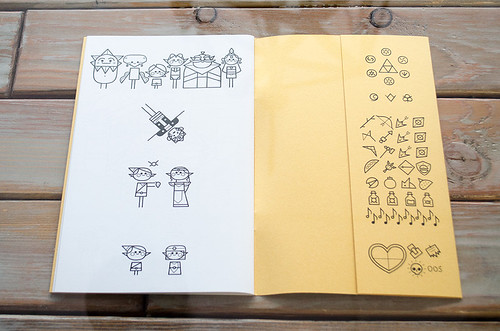
Ah...The Legend of Zelda: Ocarina of Time. So I suppose the best thing to do is quote the small introduction that's on the inside flap of my zine:

"The year was 1998. I’m sure a bunch of really important stuff happened but I was 12 so what stood out to me was a video game. For Christmas that year i was given The Legend of Zelda: Ocarina of Time, and it was awesome. Looking back I appreciate so much more than the plot or the graphics. I mean everything about the game is still great, but there’s something more that left such an impression on me. Around this time, I’d never heard of a Zelda game and my parents rarely took chances on something so expensive. The serendipity of them making such a great choice, without any prompting or research, just doesn’t happen anymore. In the age of previews for movie trailers, it’s hard to come by genuine surprise and I appreciate that this game provided me with that. Discovery is what the franchise is all about and I couldn’t have had a truer experience than with this installment. That’s why I still love it to this day. So to commemorate the year of its release I wanted to take this teeny tiny trip through time. Enjoy!"


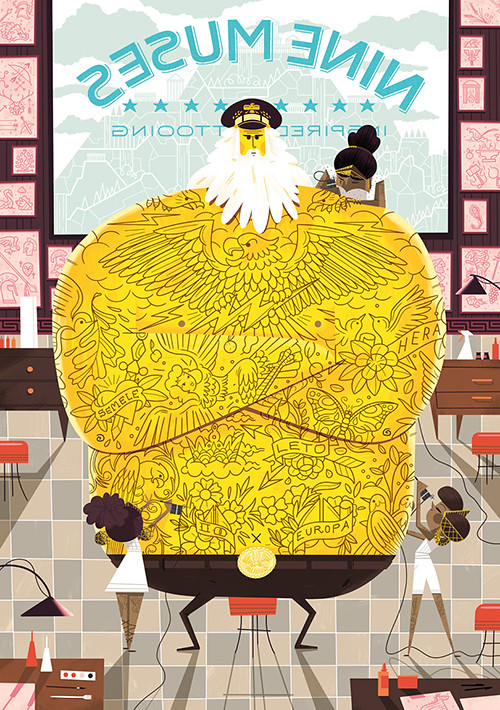
Andrew Kolb Mused on Tattoos Series- Young Guns of Print art show at Hero Complex Gallery.

What are you currently making? What can we look forward to seeing?

Well I've just gone back and revamped my personal project: The Silly Rally where I illustrate and animate goofy racers and their vehicles. I'm regularly updating and you can expect lots of "silly" from the series.

Oh but the BIG thing that's coming up is my first picture book! I haven't really talked about it that much yet but it's now available for preorder on Amazon so I should probably start promoting it, right? So it's called Edmund Unravels and it's about a little ball of yarn who adventures despite getting smaller as he goes and the importance of surrounding yourself with those you care about.

Other than that, I suppose there are more gallery shows and fun projects in the queue but all of those secrets are still kept under lock and key.


What is the best project you have ever worked on and why? (Personal or professional)

Like a good parent and their children, I'll never admit to having a favorite!

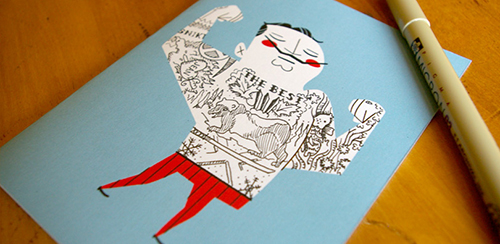
Andrew Kolb Tattoo It Yourself Cards

What are your favorite resources/ inspiration?

My big-picture inspirational people are the likes of Mary Blair and Mike Mignola. While they're of a different time, aesthetic, and content, they both approach their work with a simplicity that quickly communicates tone and content. I'm always inspired by those who are visually efficient and If I can be half as effective as the likes of them, I'll be on my way.

Outside of the art world, I'm an avid reader and love seeing how pictures are crafted with the written word. In the same way, I'm amazed when an author can take two relatively simple sentences and immediately paint a vivid mental picture. I don't have any direct examples to source but I'm reading "Neuromancer" by William Gibson right now and he's definitely concise in his writing.


Thanks Andrew!

You can find more information about Andrew's work for the Stacks Exhibition on the Light Grey Shop or permanent online gallery here. You can also see his process sketches and upcoming works on his blog and website!

Tuesday, August 19, 2014

Artist Interview with Rosena Fung

Rosena Fung
Rosena Fung is an illustrator and comic artist hailing out of Toronto. She began her path to visual narrative a little differently–she attended the University of Toronto and received her Masters in Anthropology, intending on becoming a research professor. She spent so much time drawing while attending UToronto that after finishing school there, she went to OCAD University to study Illustration. She finds it is one of the best things she has ever done.
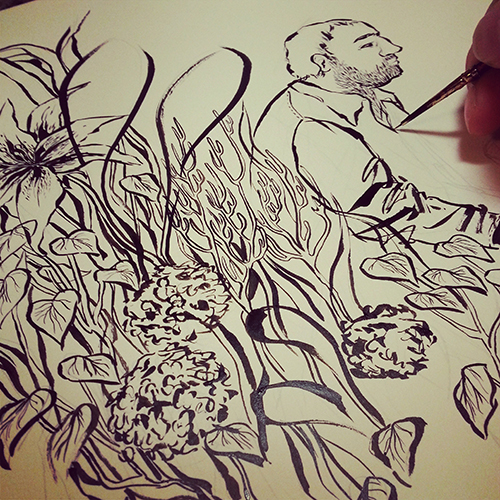
RFung wip
Could you tell us about your current studio practice? (Your physical space, the kinds of projects that you make and subjects?)

My current studio space is fairly limited: a desk, with a drawer of supplies in my room, and I am learning to adapt to a downsized space as I prepare to move. I have discovered that I'm a social artist, and work best in the company of other artists, so hopefully at some point I can work in a shared studio space.
My main projects are illustrations (from concept-driven to dense and detailed worlds) and comics (both shorts and longer narratives). I learned how to screenprint recently and have been making prints and book arts ever since. I also really love hand-drawn typography.
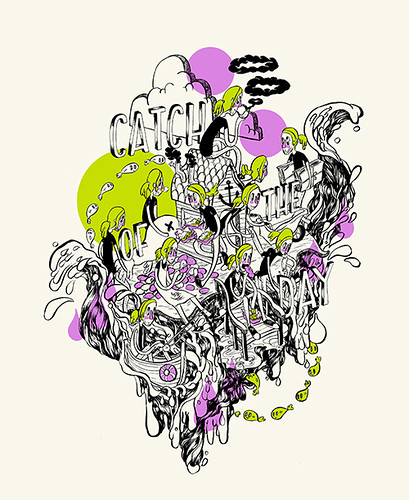
RFung Catch
Catch of the Day

What are some of your biggest sources of inspiration? (travel, subjects, materials, etc. )

I love eating, so food and the experience of eating (dining out, as a social activity, as a metaphor, etc.) is one of the mainstays of inspiration and subject matter. Besides that, other sources of inspiration include daily life, especially the really mundane stuff, and conversations, comics, fiction and non-fiction books, and drawing really late into the night—that's when the world seems to open up.

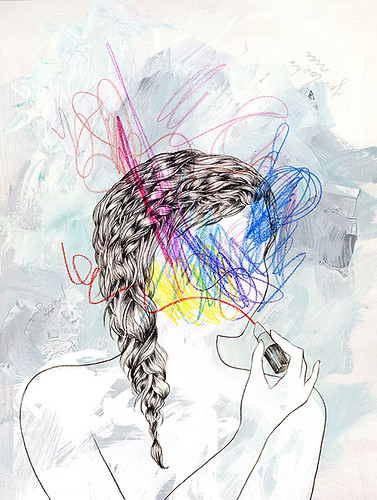
RFung Makeup
Makeup
You do many different kinds of projects, including comics, illustrations, drawings, personal and client based works. What are some of the biggest differences between your process while making completing these projects?

The differences in the process depends on the nature of the project, and who it's for. For most illustrations I approach in a very controlled sort of way. It's actually a lot of writing down ideas, symbols, associations, etc., that happens before I begin drawing, or even thumbnailing. There's definitely a very structured approach that follows a specific sequential process, especially so when working for a client.
I approach comics with more of a free hand in terms of subject matter, visual approaches, and story-telling. They remain deeply personal and less constrained by notions of what something should look like or abiding by certain conventions. When I work on a comic, I think about the kind of story I'd like to tell and why it's interesting, and go from there, without specific expectations of what I think it should be. Sometimes I'm surprised by the direction they go in, and it's a lot like watching a film play out in my head and I'm just documenting it.
While the processes are very different, they work for the each particular project so I can't say that one way is better than the other. A lot of the creative process is about adapting to each project in any case and remaining open to ideas, influences, and ways of working,

You are one of the participating artist in the Stacks Exhibition. Could you talk about your year, zine, and the behind-the-scenes work for this particular piece?
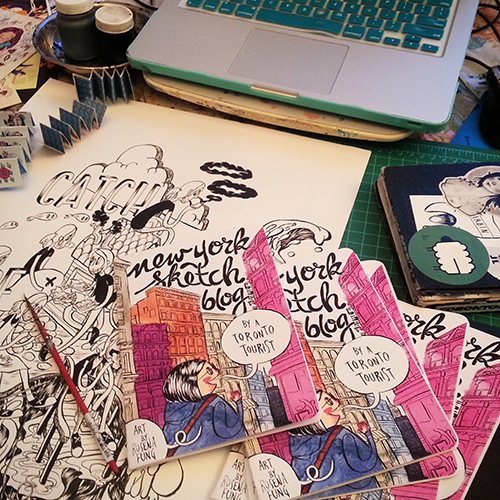
RFung Workspace
My year for the Stacks Exhibition is 2013. For my zine, I depicted my trip to New York City, the first time I had ever gone. I went with some friends to attend the Society of Illustrators' Student Scholarship Show and it was four days of the most fun I've ever had in my life with such an amazing and talented group of people. I fell in love with the city, its energy and people. When I came back, I wanted to capture its effervesence and the immediacy of each moment as I experienced it.

What are some of your most important moments in the past thirty years for your creative career? (The year you decided to go to school? The time you saw... The first time you picked up a material, etc. )

In Grade 7 a friend brought in a Calvin and Hobbes collection, It's a Magical World, and I read it for the first time. I think that was one of the most seminal moments of my creative career. I had been drawing comics before that, but they took on a concrete form from then on. I really started to seriously look at sequential art and storytelling as a compelling medium for art and writing.
Going to OCAD University was a crucial part of my creative development. I learned so much in such a short period of time, not just about image-making, but in terms of self-development and the program really instilled in me a stringent work ethic. I met some of the most brilliant, talented, and generous people at that school, whose work I greatly admire and who have helped me so much in my own work.
RFung Firstperiod
First Period


The Stacks zines are not only presented in the gallery, but also given to each of the contributing artists. Did this add additional pressure, inspiration, motivation?

The nature of the Stacks exhibit and project was inherently personally motivating. I love zines so much; they can be raw and honest, and really heartbreakingly beautiful. The idea of authenticity is often ridiculed and debated in the context of postmodernism and irony, but zines are one of the very few things I can say feels very authentic; regardless of the motivations of the creator and its influences, there is still something very honest and personal about zines. Knowing that I was part of a project of this scope was amazing.

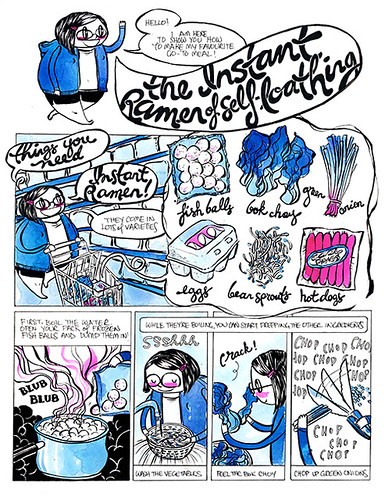
RFung Instant Ramen
Instant Ramen of Self-Loathing, page 1

There seems to be an inherent sense of community built into the world of comics. Could you share your experiences with collaboration, sharing projects, and conventions?

In the past few months, I've started discussing with other friends about different collaborative projects. Working solitary for your entire life and suddenly opening up your personal creative process can be intimidating, but also incredibly rewarding. We shall see how it goes, but I'm pretty excited about the prospects!
Zines and comic fairs are very fun: they are full of great collective energy and you meet really awesome people. Last year I co-organized a zine fair last year, and I attend as many as I can in the city. There's something special about the comics and zine community: if you're doing it, it's because you love it, unequivocally. And so meeting other comic creators and their fans is like a homecoming.

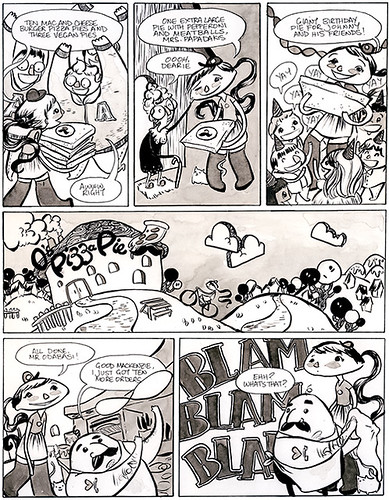
RFung Pizza Pie
Pizza Pie Wars, page 2

What projects are you currently working on?

I've got a few projects on the go right now. I'm currently working on a compilation of autobiographical comic shorts for a new zine, as well as writing a longer comic story that I want to risograph. I'm also working on a new illustration and typography portfolio: I'm very excited to try new media, expand my visual vocabulary, just try new things out.

What are some of your favorite resources? Best places, books, movies, website for inspiration?

I love hanging out at the public library, Toronto has probably one of the best public library systems, ever. My favourite resources for inspiration are comics, but it would be impossible to whittle down a list of favourite creators. Anything by Jillian Tamaki would top that list though, for both illustration and comics. Also a fan of Wes Anderson and Charlie Kaufman movies, and anything written by David Foster Wallace. I also enjoy looking at a lot of different design and illustration blogs, plus I am religiously addicted to Sam Weber's podcast Your Dreams My Nightmares. I'd say a lot of the people around me are the greatest resources I have—the community of other illustrator- and artist-friends who are in it with me together. They are great and I love them!

Thank you, Rosena! If you'd like to see more of Rosena's work, or follow her artistic activity, you can check out her website, blog, and follow her on Twitter and Instagram.